January 1, 2026
Dubai vs. Singapore: The Best Stopover City—and Why
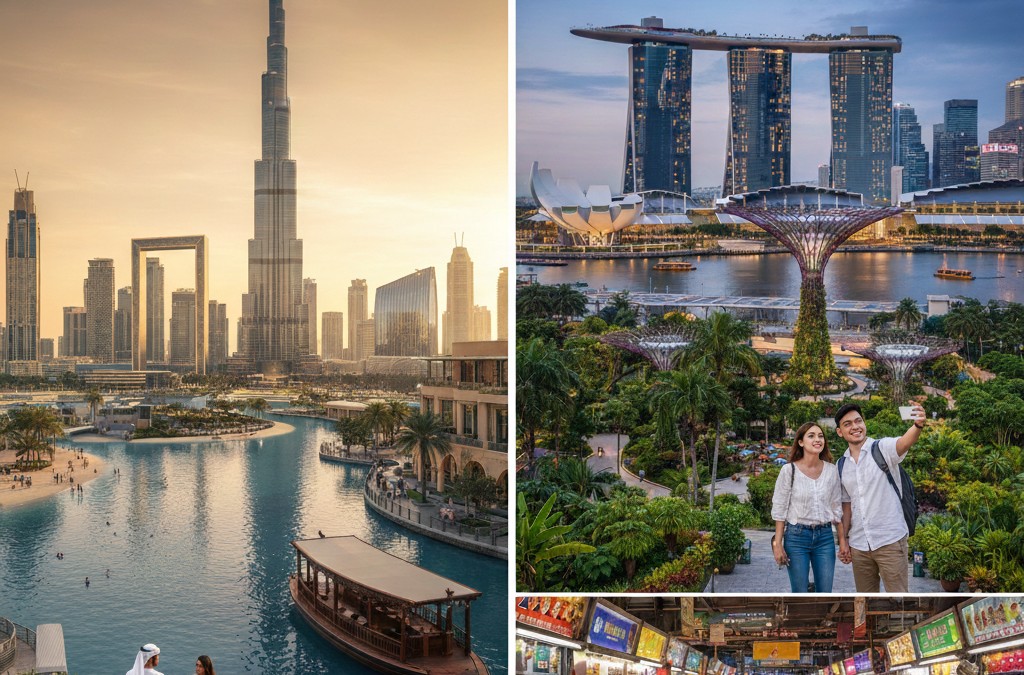
Thesis: Dubai and Singapore aren’t competing to be the best stopover city overall—they’re competing to serve very different traveler needs in the same global transit moment.
Stopovers used to be accidental. Now they’re strategic.
As long-haul travel rebounds and airlines actively promote multi-day layovers, the stopover city has become a meaningful part of the journey—not a break in it. Two cities dominate this conversation: Dubai and Singapore.
Both are impeccably connected. Both are built for international travelers. And yet, they deliver fundamentally different experiences in the same 24–72 hour window.
Why stopover cities matter more than ever
Stopovers solve three modern travel problems at once:
-
Long-haul fatigue
-
Airline routing efficiency
-
Travelers’ desire to “see more without committing more time”
Estimate: Travelers are increasingly willing to add 1–3 nights to long-haul itineraries if friction is low and value is clear.
That puts pressure on stopover cities to be:
-
Easy
-
Flexible
-
Immediately rewarding
Dubai and Singapore both meet that bar—but in very different ways.
Geography and flight logic
Dubai excels as a midpoint connector between Europe, Africa, Asia, and Australia. Many itineraries naturally pass through it.
Singapore, meanwhile, is a gateway city for Southeast Asia and Oceania—often closer to the destination than the midpoint.
This matters because:
-
Dubai stopovers often feel like a dramatic pause
-
Singapore stopovers often feel like a soft landing
Ease of entry and movement
Both cities are operationally excellent.
Singapore prioritizes:
-
Fast airport processing
-
Compact geography
-
Predictable transit times
Dubai prioritizes:
-
Scale
-
24/7 availability
-
High-capacity infrastructure
Estimate: Travelers in Singapore spend less time navigating and more time doing within the same 48-hour window.
The stopover experience: stimulation vs. efficiency
Dubai’s scale and spectacle
Dubai is designed to impress immediately.
In a short stopover, travelers can:
-
Visit multiple landmark attractions
-
Dine at globally recognized venues
-
Experience climate-controlled comfort year-round
Real-world example #1:
A business traveler added a 2-night Dubai stopover.
-
Hotel cost: higher than planned
-
Total activity density: high
-
Reported feeling: “energized but busy”
Dubai rewards travelers who want intensity.
Singapore’s precision and calm
Singapore plays a different game.
In the same timeframe, travelers often:
-
Explore one or two neighborhoods deeply
-
Eat exceptionally well with minimal planning
-
Move effortlessly between airport, hotel, and city
Real-world example #2:
A leisure traveler added a 2-night Singapore stopover.
-
Hotel cost: comparable to main destination
-
Daily walking distance: lower
-
Reported feeling: “rested and reset”
Singapore rewards travelers who want flow.
Time, cost, and value during short stays
Stopover economics matter because stays are short.
Dubai:
-
Often offers competitive hotel deals
-
Higher discretionary spend on activities
-
Transport costs add up quickly
Singapore:
-
Higher baseline costs
-
Lower friction and fewer “extras”
-
Spend concentrates on food and lodging
Estimate: Stopover satisfaction correlates more strongly with ease than price when stays are under 72 hours.
Real-world stopover examples with numbers
Example #3: Family stopover comparison
A family considered both cities for a 48-hour stop.
Dubai:
-
Required private transport
-
Higher attraction spend
-
High stimulation, low downtime
Singapore:
-
Used public transport exclusively
-
Lower activity spend
-
Higher overall comfort
They chose Singapore—and extended the stay by one night.
What this means for travel agencies
Stopovers are advisory moments.
Actionable steps for agencies:
-
Match stopover city to energy level, not status
-
Recommend Dubai for travelers seeking spectacle
-
Recommend Singapore for travelers needing recovery
-
Design stopovers around one anchor experience per day
-
Monitor hotel pricing post-booking—short stays are sensitive to rate shifts, making tools like Rebookify especially effective without reopening decisions
Selling the right stopover builds trust. Selling the “flashier” one doesn’t always.
Decision helper: Dubai vs. Singapore stopover fit
| Traveler Priority | Dubai | Singapore |
|---|---|---|
| Landmark density | High | Moderate |
| Ease of movement | Moderate | Very high |
| Downtime quality | Lower | Higher |
| Cost predictability | Variable | Stable |
| Best for | High-energy travelers | Reset-focused travelers |
Quick takeaways
-
Stopovers are now strategic, not accidental
-
Dubai and Singapore solve different travel problems
-
Dubai maximizes stimulation in short timeframes
-
Singapore maximizes ease and recovery
-
Agencies win by matching energy, not prestige
Common mistakes
-
Treating all stopovers as interchangeable
-
Overloading short stays with activities
-
Ignoring transport friction
-
Choosing based on brand recognition alone
-
Failing to optimize hotel pricing after booking
Conclusion
Dubai vs. Singapore isn’t a question of which city is better—it’s a question of what the traveler needs mid-journey.
Dubai excels when travelers want a bold interruption. Singapore excels when they want continuity and calm. The best stopover city is the one that supports the rest of the trip—not competes with it.
For travel agencies, that distinction is where real value lives.