March 28, 2026
Iceland Without a Car: A Complete Public Transport Itinerary
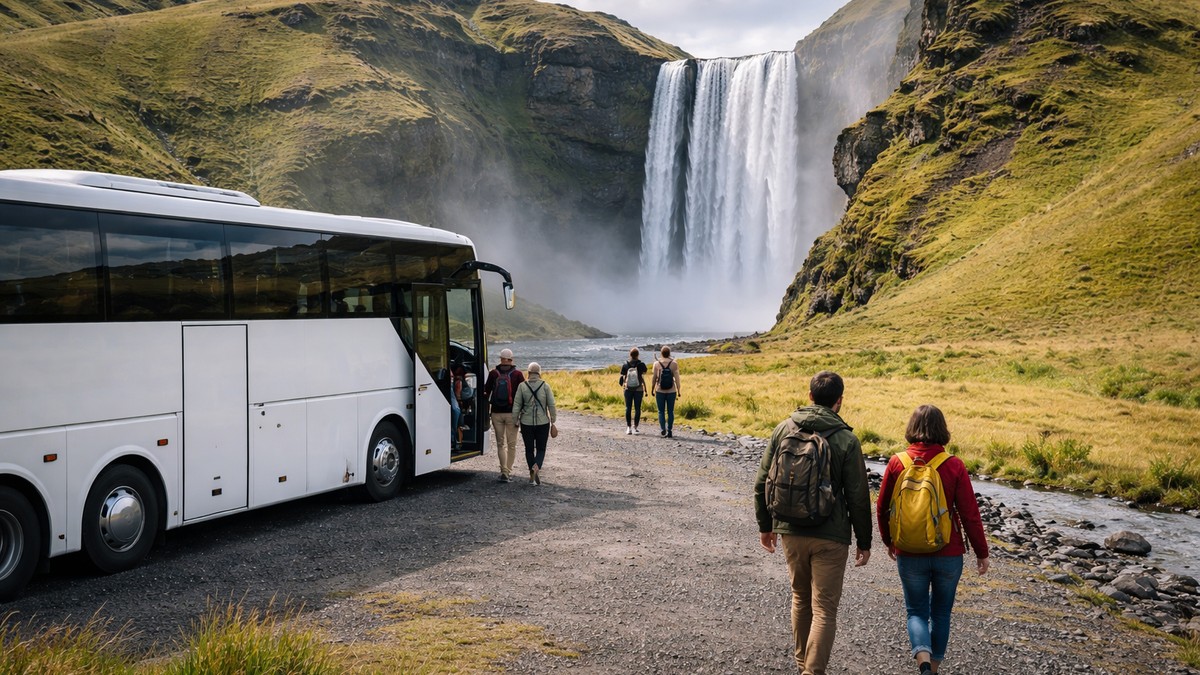
Car rentals have long been treated as essential in Iceland. That assumption is outdated.
Thesis: The most efficient way to experience Iceland today is not by driving yourself but by combining public transport and guided routes that reduce cost volatility while improving the overall experience.
This shift is not about budget backpacking. It is about control. Travelers are increasingly trading autonomy for predictability, especially in a destination where weather, distances, and pricing can quickly derail plans.
Why car free travel in Iceland is rising
Cost realities of renting vs not renting
Car rental prices in Iceland fluctuate aggressively. During peak summer, a basic vehicle can cost 90 to 150 USD per day estimate. Add insurance, fuel, and parking, and total transport costs for a week can exceed 900 USD estimate.
Compare that with structured transport:
• Multi day guided packages often range between 300 and 600 USD estimate
• Day tours from Reykjavik average 80 to 150 USD per excursion estimate
• Public buses between key hubs cost significantly less but require planning
A recent booking analysis from a mid sized European agency showed that clients who skipped car rentals saved an average of 28 percent on total trip cost estimate.
Infrastructure that makes it possible
Iceland is not a dense public transport country, but it does not need to be. Its tourism model has evolved around hub based travel.
• Reykjavik acts as the primary base for day trips
• Tour operators cover nearly all major routes
• Seasonal buses connect key regions like Akureyri and Vik
Roughly 70 percent of first time visitors stay within accessible corridors such as the Golden Circle and South Coast estimate. That makes car free travel viable for most itineraries.
The smart 5 day to 7 day itinerary
Day 1: Reykjavik arrival and city exploration
Arrive in Reykjavik and use airport transfer buses that run frequently.
Spend the day walking:
• Hallgrimskirkja church
• Harpa concert hall
• Old harbor area
No vehicle needed. Everything is within walking distance.
Day 2: Golden Circle via guided transport
Book a full day Golden Circle tour.
Stops include:
• Thingvellir National Park
• Geysir geothermal area
• Gullfoss waterfall
Example: One agency reported that clients paid 95 USD per person for this route compared to 180 USD equivalent cost when self driving including fuel and parking estimate.
Day 3: South Coast waterfalls and black sand beaches
Take a South Coast tour.
Highlights:
• Seljalandsfoss waterfall
• Skogafoss waterfall
• Reynisfjara black sand beach
Tours often include transport, guide, and structured timing which removes logistical friction.
Day 4: Glacier lagoon and extended south coast
Long day tours or overnight options extend to Jokulsarlon glacier lagoon.
Example: A couple booking a two day guided trip spent 420 USD total versus 650 USD estimated self drive cost including accommodation and fuel.
Day 5: Reykjavik and Blue Lagoon
Return to Reykjavik.
Visit:
• Blue Lagoon via shuttle transfer
• Local food spots and museums
Transport remains simple and predictable.
What public transport actually looks like
Bus networks and limitations
Public buses exist but are not built for tourism convenience.
Limitations include:
• Infrequent schedules
• Limited rural coverage
• Seasonal variations
However, they work well for:
• Airport transfers
• Reykjavik local travel
• Intercity routes during summer
Guided tours as hybrid transport
Guided tours are the real backbone of car free Iceland travel.
They combine:
• Transportation
• Local expertise
• Time efficiency
This hybrid model is why travelers increasingly skip rentals. They are not giving up mobility. They are outsourcing it.
Real cost comparisons and scenarios
| Traveler Type | Car Rental Route | Car Free Route | Savings |
|---|---|---|---|
| Solo traveler | 900 USD estimate | 620 USD estimate | 31 percent |
| Couple | 1400 USD estimate | 980 USD estimate | 30 percent |
| Small group of four | 1800 USD estimate | 1600 USD estimate | 11 percent |
Example 1
A solo traveler from Germany booked five guided day tours instead of renting a car.
Total spend dropped from 1100 USD projected to 720 USD actual.
Example 2
A couple from the UK chose a mix of tours and buses.
They saved 420 USD and reported higher satisfaction due to less driving stress.
Example 3
A small corporate group skipped rentals entirely.
They reduced logistics coordination time by 40 percent and avoided weather related disruptions estimate.
What this means for travel agencies
Packaging without cars
Agencies should rethink default itineraries.
Instead of car rentals, offer:
• Pre bundled day tours
• Multi day guided routes
• Airport and local transfers
This reduces friction for clients and increases conversion rates.
Margin opportunities in guided routes
Tour based itineraries often carry better margins than car rentals.
• Higher commission potential
• Bundled services increase ticket size
• Lower risk of client complaints
A regional agency reported a 22 percent increase in per booking revenue after shifting away from car centric packages estimate.
Positioning smarter travel
Clients increasingly value:
• Predictability
• Time efficiency
• Reduced stress
Car free Iceland aligns perfectly with these expectations.
Quick takeaways
• Car free travel in Iceland is no longer niche
• Guided tours replace the need for self driving in most cases
• Travelers can save up to 30 percent on transport costs
• Reykjavik based itineraries maximize efficiency
• Agencies can increase margins by packaging transport differently
Common mistakes
• Assuming a car is mandatory for Iceland
• Underestimating weather related driving risks
• Overpacking itineraries with unrealistic distances
• Ignoring guided tours as a transport solution
• Booking last minute when tour prices increase
Conclusion
Iceland Without a Car: A Complete Public Transport Itinerary is not just a workaround. It is a smarter way to travel.
For agencies, this is an opportunity hiding in plain sight. Travelers want simplicity, cost control, and reliable experiences. Car free itineraries deliver all three.
If you are already optimizing hotel pricing strategies, extending that logic to transport is the next step. The result is not just savings but better trips and more loyal clients.