March 17, 2026
The One Neighborhood Only Trip Can It Beat Seeing Everything
Modern travel often feels like a race.
Travelers land in a city and immediately start collecting landmarks. Museums. Viewpoints. Restaurants recommended by social media.
By the end of the trip they have seen everything.
And experienced very little.
The one neighborhood only trip challenges this model by focusing an entire visit on a single district rather than an entire city.
The idea sounds counterintuitive.
But for many travelers it produces a deeper and far more memorable experience.
For travel agencies and trip planners this approach is becoming one of the most interesting shifts in urban travel design.
The Problem With Seeing Everything
The checklist travel mindset
City travel often follows a familiar formula.
A traveler visits
• the main monument
• the famous museum
• the popular viewpoint
• the most photographed street
Then repeats the process across multiple neighborhoods.
This approach creates impressive photo collections.
But it also creates a fragmented experience.
A typical traveler in a major city like Paris may attempt to see six to eight major attractions in a single day estimate.
The result is often long transit rides between districts and hours spent waiting in lines.
In practice many travelers spend more time moving between attractions than experiencing the city itself.
Urban travel fatigue
City exhaustion is a real phenomenon.
Research from a European tourism study found that over 60 percent of travelers report feeling rushed during city trips estimate.
When every day is tightly scheduled the city becomes a checklist.
Not a place.
This is where the one neighborhood strategy begins to shine.
The One Neighborhood Travel Strategy
What it means in practice
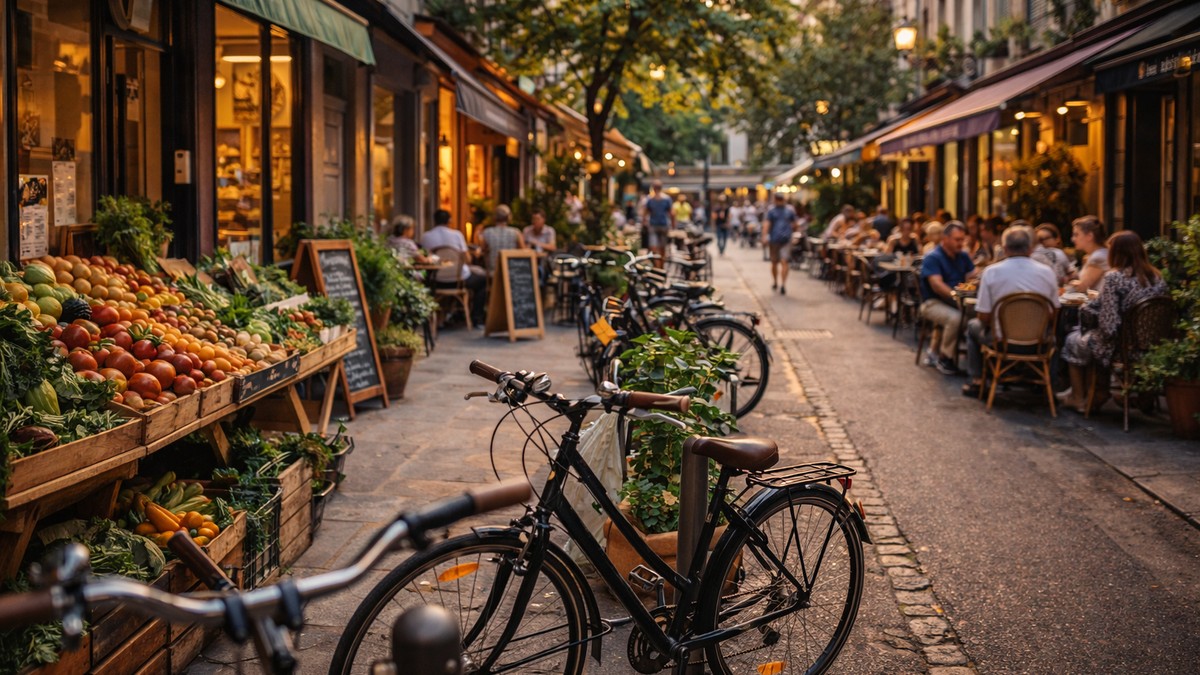
A one neighborhood trip focuses the entire visit within a small geographic area.
Instead of crossing the city repeatedly travelers stay within walking distance of most activities.
They visit
• local cafés
• neighborhood markets
• nearby parks
• independent shops
• community restaurants
The goal is immersion.
Travelers begin to recognize streets and routines.
Baristas remember them.
They discover places that never appear on travel lists.
Why immersion changes the experience
Cities are not defined by monuments.
They are defined by rhythms.
Morning bakeries opening.
Evening restaurant crowds.
Local markets.
Street musicians.
These everyday moments rarely appear when travelers rush from one attraction to another.
But they define the character of a neighborhood.
And they are easier to experience when travelers slow down.
Real World Examples Of Neighborhood Based Travel
Tokyo districts
Tokyo is often seen as overwhelming.
The metropolitan area contains more than 37 million people, making it the largest urban population in the world.
Yet many travelers who focus on a single district find Tokyo surprisingly manageable.
A visitor staying entirely in Shibuya can spend several days exploring
• hidden ramen shops
• small vinyl record bars
• neighborhood parks
• boutique clothing stores
One travel advisor reported designing a three day Shibuya focused itinerary for a client who previously visited Tokyo twice.
The client ended up visiting over 25 small local businesses within walking distance of the hotel estimate.
The trip felt richer than their previous city wide visits.
Paris neighborhoods
Paris is perhaps the classic example of neighborhood travel.
The city’s arrondissements already function like small communities.
A traveler staying in Le Marais can explore
• historic streets
• art galleries
• Jewish bakeries
• independent fashion shops
One Paris tour operator noted that guests who spent three days entirely in Le Marais reported higher satisfaction scores than those following traditional multi district itineraries estimate.
The slower pace allows visitors to experience the city’s social life rather than simply its monuments.
Barcelona local districts
Barcelona’s neighborhoods each have distinct identities.
Gracia offers village like streets.
El Born combines history with nightlife.
Sant Antoni focuses on food culture.
One travel consultancy tested neighborhood based itineraries in Barcelona.
Clients who followed neighborhood focused plans reported spending 30 percent less time in taxis or public transit estimate.
More time was spent walking and exploring.
Which ultimately improved the experience.
Decision Table For Travel Styles
| Travel Style | Experience Type | Typical Outcome |
|---|---|---|
| Checklist tourism | Multiple districts and attractions | Broad but shallow experience |
| Fast paced city break | Landmark focused schedule | Time pressure and fatigue |
| Neighborhood focused travel | Local immersion | Deeper cultural understanding |
| Slow urban travel | Walking based exploration | Higher traveler satisfaction |
The comparison shows why neighborhood focused travel often produces stronger memories.
Depth tends to outperform coverage.
Quick takeaways
• Urban travel fatigue often comes from trying to see too much
• Focusing on one neighborhood allows deeper local experiences
• Walking based exploration reduces transit time
• Travelers often discover hidden places not listed in guidebooks
• Slow neighborhood travel improves overall trip satisfaction
What This Means For Travel Agencies
Neighborhood focused travel opens several new opportunities for agencies.
Instead of selling only attraction tickets and city tours agencies can design immersive district based experiences.
Practical strategies include
• building itineraries around walkable districts
• recommending boutique hotels within vibrant neighborhoods
• partnering with local restaurants and guides
• designing food walks and market visits
• creating multi day neighborhood immersion experiences
Operational efficiency also improves.
Travel logistics become simpler when most activities occur within a small area.
This approach can also influence hotel booking strategies.
Neighborhood immersion works best when accommodations are well located and competitively priced.
Travel agencies that monitor hotel prices after booking can increase margins while protecting client budgets.
Tools such as Rebookify allow agencies to automatically track hotel rate changes and rebook if prices drop.
For agencies managing large numbers of urban stays this can significantly improve profitability.
Common mistakes
• choosing neighborhoods that lack cultural activity
• booking hotels far from the district center
• trying to combine neighborhood travel with too many attractions
• ignoring local markets and community spaces
• planning too many scheduled activities
• failing to allow time for spontaneous exploration
The one neighborhood trip only works when travelers embrace flexibility.
Conclusion
The One Neighborhood Only Trip Can It Beat Seeing Everything is not just a provocative question.
For many travelers the answer is yes.
Cities are complex ecosystems of culture, food, and daily life.
Trying to experience everything often means experiencing nothing deeply.
By focusing on a single district travelers gain something far more valuable than a checklist.
They gain familiarity.
They gain stories.
And most importantly they gain a sense of place.
In an age of rushed travel the most memorable trips may come from simply slowing down and staying put.