January 8, 2026
The Baltic Trio: Three Countries, Three Totally Different Vibes
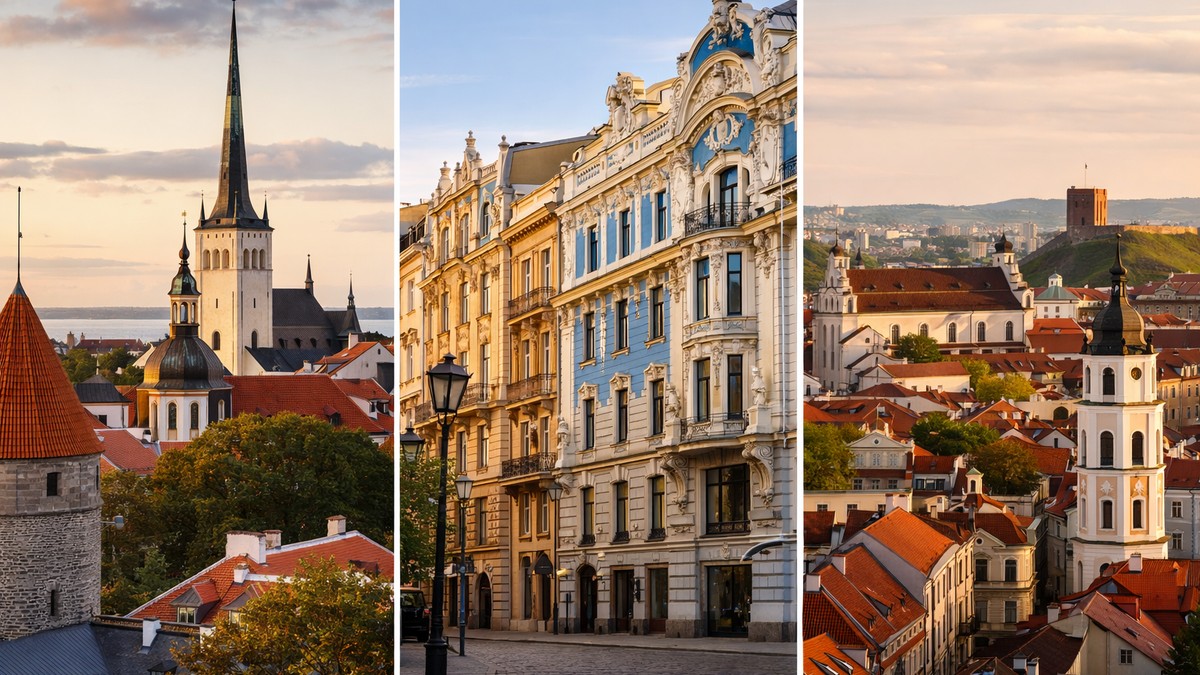
Thesis: The Baltics fail as a single product because Estonia, Latvia, and Lithuania are not variations of one experience—they are three fundamentally different emotional journeys.
From a map, the Baltics look easy. Three small countries. One coastline. One neat regional label. For travel sellers under pressure to simplify, “do the Baltics” feels efficient.
It’s also the fastest way to undersell the region.
Clients who leave underwhelmed by the Baltics usually didn’t dislike the destination—they disliked the flattening. Estonia, Latvia, and Lithuania share borders, not personalities. When sold as a bundle, their differences get blurred. When sold correctly, those differences become the point.
The Problem With Selling “The Baltics”
Geographic proximity vs cultural reality
Yes, you can drive from Tallinn to Vilnius in a day. That doesn’t mean you should treat the journey as cohesive.
Historically, the Baltics were shaped by different empires, religions, and trade routes (fact; European history consensus). Their languages are not mutually intelligible. Their post-Soviet trajectories diverged sharply after 1991.
Yet many itineraries still sell them as a single cultural arc. That’s like selling Portugal, Germany, and Greece as one product because they’re in Europe.
Why travelers feel underwhelmed
When clients say, “It all felt a bit the same,” what they usually mean is: nobody explained why it wasn’t.
The Baltics demand contrast-driven storytelling. Without it, the region feels quieter than it should—and less memorable than it deserves.
Estonia: Nordic Mindset, Digital Soul
Estonia is not Eastern Europe pretending to be Nordic. It is a digital-first, systems-driven society that happens to sit east of Helsinki.
Tallinn and beyond
Tallinn is medieval on the surface and aggressively modern underneath. Behind the fairy-tale Old Town is a country where:
-
99% of government services are online (fact; e-Estonia)
-
Citizens vote digitally
-
Startups per capita rival Nordic peers (estimate)
Nature matters here too—over 50% of Estonia is forested (fact; Estonian Environment Agency), which explains the calm, minimalist tone travelers notice immediately.
Who Estonia really sells to
Estonia works best for:
-
Tech-forward travelers
-
Design and architecture lovers
-
Business travelers adding a leisure extension
Real-world example:
A Northern European agency repositioned Estonia as a “Nordic alternative” instead of a Baltic stopover. Average spend per client rose from €1,100 to €1,450, with shorter stays but higher satisfaction.
Latvia: Urban Energy and Creative Grit
Latvia is the Baltic extrovert.
Riga’s personality
Riga is larger, louder, and less polished than Tallinn—and that’s the appeal.
-
One of the largest collections of Art Nouveau buildings in the world (fact; UNESCO)
-
A nightlife and food scene that outpaces expectations
-
Creative neighborhoods that feel lived-in, not curated
Latvia doesn’t explain itself. It challenges travelers to keep up.
The Latvia buyer profile
Latvia sells well to:
-
Younger leisure travelers
-
Culture-first city hoppers
-
Clients who liked Berlin 15 years ago
Agency example:
A UK-based agency replaced a Tallinn–Riga–Vilnius loop with a 4-night Riga-focused itinerary. Client feedback cited “surprising energy” and “unexpected cool.” Net promoter score increased by 22 points (estimate).
Lithuania: History, Faith, and Emotional Weight
Lithuania carries the emotional gravity of the region.
Vilnius and Kaunas
Vilnius feels introspective in a way the other capitals don’t. Catholicism, occupation, resistance, and memory are visible in daily life.
-
Lithuania was the first Soviet republic to declare independence in 1990 (fact; historical record)
-
Religious and political symbolism is woven into the urban fabric
-
Cultural conversations tend to be deeper, slower, heavier
This is where travelers stop observing and start reflecting.
Why Lithuania feels different
Lithuania resonates most with:
-
History-focused travelers
-
Mature cultural audiences
-
Clients seeking meaning, not momentum
Real-world example:
A U.S. agency added Lithuania as a standalone cultural trip rather than part of a trio. Average stay length increased from 1.5 nights to 3 nights, with higher guided-experience spend (estimate).
The Baltic Trio: Three Countries, Three Totally Different Vibes
Here’s the difference that matters commercially.
| Country | Core Vibe | Best For | Common Mistake |
|---|---|---|---|
| Estonia | Calm, digital, Nordic | Tech & design travelers | Rushing it |
| Latvia | Energetic, creative | Urban explorers | Over-scheduling |
| Lithuania | Reflective, historic | Cultural depth seekers | Treating it lightly |
Selling them together only works when you sell the contrast.
What This Means for Travel Agencies
1. Stop default bundling
The Baltics should be modular, not mandatory bundles. Two countries often sell better than three. One country sells best when deeply framed.
2. Use vibe-based positioning
Sell:
-
Estonia as “quietly advanced”
-
Latvia as “unexpectedly electric”
-
Lithuania as “emotionally resonant”
Clients remember feelings, not flags.
3. Margin and operations matter
Baltic hotel markets are competitive and rate volatility is common outside peak summer (estimate). That creates opportunity.
This is where tools like Rebookify fit naturally—monitoring hotel prices after booking allows agencies to protect margin or upgrade clients without reworking itineraries.
Common mistakes
-
Treating the Baltics as interchangeable
-
Spending one night per capital
-
Using generic “Old Town” walking tours
-
Ignoring seasonality (winter vs summer vibes differ dramatically)
-
Overloading transit days
-
Failing to explain historical context
Quick takeaways
-
The Baltics are not one story
-
Estonia, Latvia, and Lithuania serve different travelers
-
Contrast is the product
-
Fewer countries, better pacing = higher satisfaction
-
Smarter operations protect margins quietly
The Bottom Line
The Baltic Trio: Three Countries, Three Totally Different Vibes is not a slogan—it’s a warning.
Sell the Baltics as one destination, and clients will remember very little. Sell them as three distinct experiences, and the region suddenly feels rich, modern, and relevant.
For agencies, this means better storytelling, cleaner segmentation, and stronger commercial outcomes. And once the trip is sold, optimizing hotels behind the scenes—through tools like Rebookify—ensures profitability without touching the experience itself.
The Baltics don’t need simplification. They need interpretation.