January 13, 2026
The Role of Smart Alerts in Modern Travel Planning
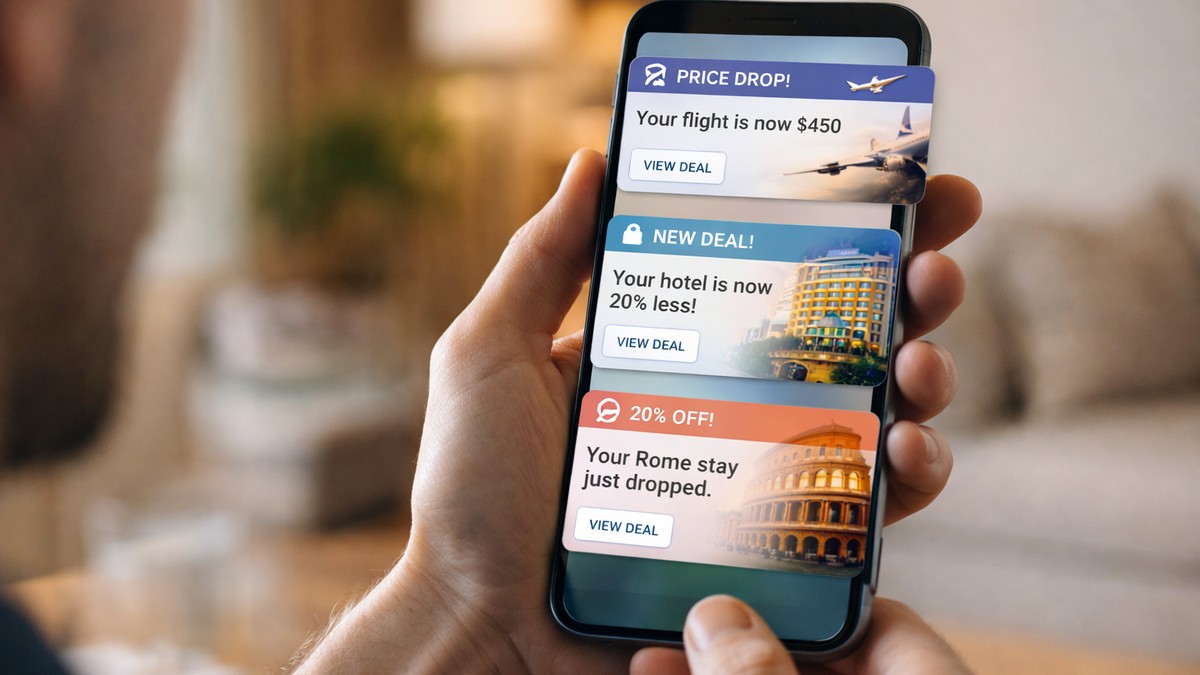
Thesis: In a world of volatile pricing, the advantage no longer belongs to the best planner but to the best responder.
Travel planning used to be about preparation. Research destinations. Compare options. Pick a moment. Book and move on.
That mental model is outdated.
Today, pricing shifts constantly. Availability changes unpredictably. Promotions appear quietly and vanish quickly. The traveler who succeeds is not the one who planned hardest. It is the one who stayed aware the longest.
This is where The Role of Smart Alerts in Modern Travel Planning becomes central rather than optional.
Why Static Planning No Longer Works
Pricing volatility
Travel pricing is no longer stable enough to treat booking as a one time event.
Airfare pricing can change multiple times per day on competitive routes estimate. Hotel rates in major cities frequently fluctuate by ten to twenty percent within a single week estimate. Group cancellations, weather changes, local events, and competitor discounting all affect prices in real time.
Static planning assumes stability. Modern markets punish that assumption.
Human attention limits
Most travelers do not have the time or patience to check pricing daily. They do not revisit bookings. They do not monitor multiple properties. They trust that their initial decision was good enough.
This gap between market behavior and human attention is exactly where smart alerts create value.
What Smart Alerts Actually Do
From notification to decision support
The best alerts are not noisy reminders. They are signals.
They detect meaningful change. They surface opportunity. They reduce the cognitive load on the traveler or advisor.
Instead of forcing someone to constantly check pricing, the system checks on their behalf and only interrupts when action is justified.
This transforms travel planning from a one time decision into a managed process.
Why speed matters
Price drops are often temporary. Inventory that reappears can disappear again within hours. Promotions sometimes last only until a pricing engine rebalances.
The value of alerts is not only awareness. It is timing of awareness.
Responding within hours rather than days often determines whether savings are captured or missed.
Three Real World Examples With Numbers
Leisure traveler
A traveler booked a three night stay in Amsterdam at two hundred and forty dollars per night.
A smart monitoring system detected a price drop to two hundred and five dollars two weeks later. The traveler rebooked and saved one hundred and five dollars on the total stay estimate.
Without an alert, they would never have revisited the price.
Corporate booking
A consultant booked a refundable hotel in San Francisco at three hundred and ten dollars per night.
Five days later, competitor hotels reduced rates and the property adjusted pricing to two hundred and seventy dollars.
An alert prompted the agency to rebook. The three night stay delivered one hundred and twenty dollars in savings with no change in experience.
This became a tangible demonstration of advisor value.
Multi city itinerary
A traveler with five separate hotel bookings across Europe used monitoring across all properties.
Two of the five dropped in price. Three did not.
The total net savings across the itinerary was two hundred and sixty dollars estimate.
The key insight was not that every booking dropped. It was that only systematic monitoring revealed which ones did.
How Alerts Change Traveler Behavior
From guessing to responding
Traditional travel advice often encourages guessing.
Guess the best time to book. Guess when deals might appear. Guess whether waiting will help.
Alerts eliminate guessing. They replace speculation with evidence.
Travelers move from predictive behavior to responsive behavior. They no longer try to outthink the market. They simply respond when the market changes.
From passive to proactive
Alerts also shift psychology.
Travelers feel more in control. Advisors feel more credible. Clients feel protected.
Instead of hoping they did well, they know someone is watching.
This shift has emotional value alongside financial value.
What This Means for Travel Agencies
Building trust through visibility
Clients trust outcomes more than promises.
When an advisor proactively informs a client that a hotel rate dropped and has been rebooked, trust compounds. The client sees attention in action.
Agencies using tools like Rebookify that monitor hotel prices after booking and enable rebooking transform monitoring into a service rather than a background function.
Turning alerts into client value
Alerts are not just operational tools. They are communication opportunities.
Each alert can become a client touchpoint. Each saving becomes proof of diligence. Each adjustment reinforces the advisor role as guardian of the budget.
This creates differentiation in a market where many agencies still operate reactively.
Common mistakes
-
Treating alerts as noise instead of signals
-
Setting too many alerts and ignoring the important ones
-
Relying on alerts without having a clear rebooking process
-
Forgetting to communicate savings to clients
-
Assuming initial booking decisions eliminate the need for monitoring
-
Using alerts only for inspiration rather than action
Quick takeaways
-
Pricing moves faster than human attention
-
Smart alerts bridge the awareness gap
-
The value of alerts lies in speed and relevance
-
Monitoring after booking creates measurable savings
-
Agencies can use alerts to demonstrate continuous value
The bottom line
The Role of Smart Alerts in Modern Travel Planning is not about convenience. It is about survival in a dynamic market.
Static planning belongs to a slower era. Today, attention is the scarce resource. The systems that manage attention on behalf of travelers and agencies become strategic assets.
Travelers who rely on alerts outperform travelers who rely on intuition. Agencies that integrate monitoring outperform agencies that stop at booking.
Tools like Rebookify make this shift practical by monitoring hotel prices after booking and enabling rebooking when opportunity appears.
The smartest move in modern travel is no longer predicting.
It is paying attention continuously.